
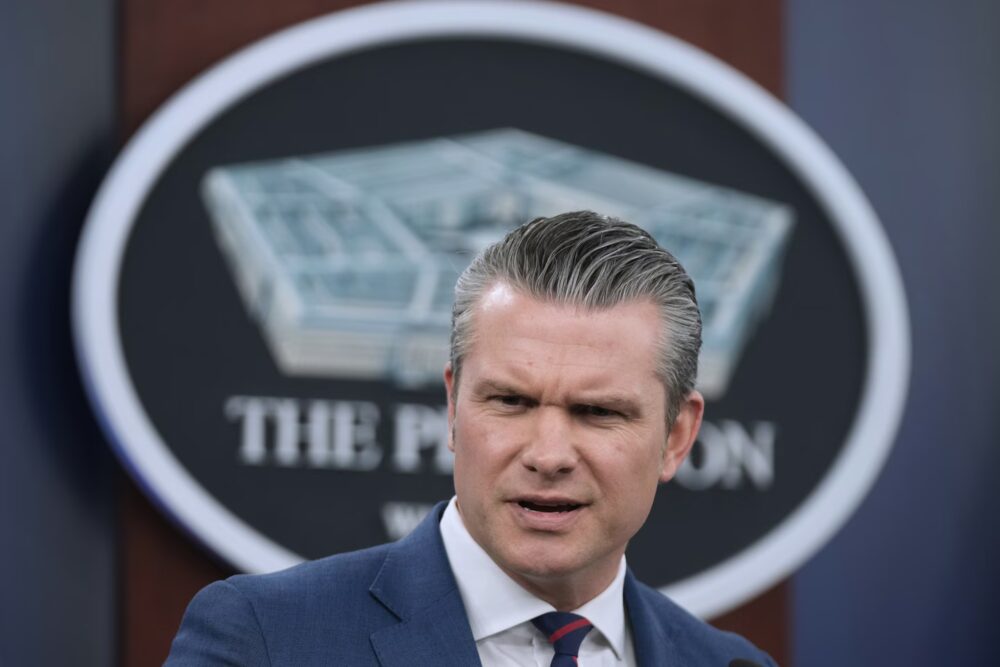
A federal judge in Washington on Friday struck down Pete Hegseth’s unprecedented restriction on the Pentagon’s press pool, ruling that the policy violated the First and Fifth Amendments.
U.S. District Judge Paul Friedman, a Clinton appointee, in a 40-page ruling noted that national security, troops, and war plans must be protected, but that it was “more important than ever that the public have access to information from a variety of perspectives about what its government is doing” in light of Trump’s recent “incursion” into Venezuela and war with Iran.
“A primary purpose of the First Amendment is to enable the press to publish what it will and the public to read what it chooses, free of any official proscription,” Friedman wrote. “Those who drafted the First Amendment believed that the nation’s security requires a free press and an informed people and that such security is endangered by governmental suppression of political speech,” he continued. “That principle has preserved the nation’s security for almost 250 years. It must not be abandoned now.”
The Pentagon’s chief spokesperson, Sean Parnell, vowed to seek an immediate appeal.
Hegseth’s decree came in October 2025, and stated that journalists can be deemed security risks and have their press badges revoked if they solicit unauthorized military personnel to disclose classified, and in some cases unclassified, information. Of the 56 news organizations in the Pentagon Press Association, only one agreed to sign an acknowledgement of the new policy. All others had their press passes revoked.
The Trump administration argued that the Pentagon’s policy could not be discriminatory because conservative and liberal journalists both refused to sign the acknowledgement. Friedman ruled that the discrimination was not against liberalism or conservatism, but the view that journalism must be independent.
“The record evidence supports the conclusion that the policy discriminates not based on political viewpoint but rather based on editorial viewpoint — that is, whether the individual or organization is willing to publish only stories that are favorable to or spoon-fed by department leadership,” Friedman wrote.
The lawsuit was brought by the New York Times alone, as other large media outlets declined to risk joining the litigation.