
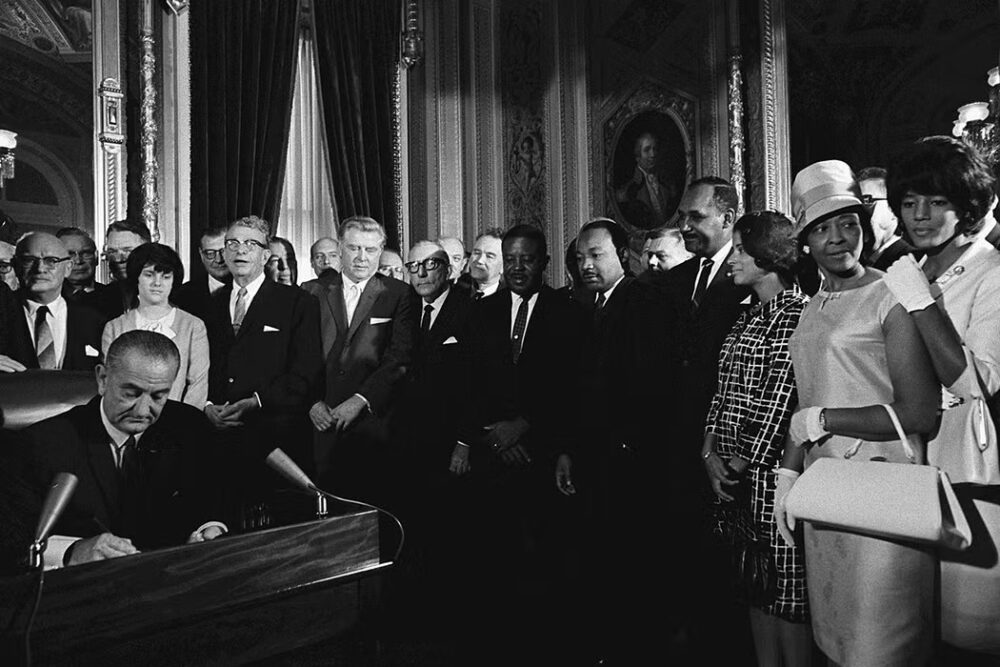
We’re going backwards, folks.
Although the Extreme Court kept Section 2 of the Voting Rights Act intact, in a 6-3 ruling, the Court held that the Louisiana’s 2024 election map, which created a second majority-Black congressional district, was “an unconstitutional racial gerrymander.”
It isn’t yet clear how the decision will affect November’s midterms. Primaries are well underway in most states.
Once considered the jewel in the crown of the civil rights movement, the Voting Rights Act has been largely dismembered since 2013 by the increasingly conservative Supreme Court. The major exception was a decision just two years ago that upheld the section of the law aimed at ensuring that minority voters are not shut out of the process of drawing new congressional district lines.
Uncles Sam Alito wrote the majority opinion and Uncle Clarence concurred:
Conservative Justice Samuel Alito, writing for the majority, said that while there may be extreme situations where the use of race can be justified to draw a map, it was not in the Louisiana case. As a result, the new map was an “unconstitutional racial gerrymander,” he added.
In a separate concurring opinion, conservative Justice Clarence Thomas, a longtime critic of the Voting Rights Act, said the ruling should “largely put an end” to a system that he saw as unlawfully dividing people into districts based on race.
Justice Kagan’s Dissenting Opinion:
In her dissent, Justice Kagan says the majority has gutted the Voting Rights Act. She concludes: “I dissent because the Court betrays its duty to faithfully implement the great statute Congress wrote. I dissent because the Court’s decision will set back the foundational right Congress granted of racial equality in electoral opportunity.”
The South Will Rise Again:
While the immediate impact of the ruling for the November midterm elections is unclear, today’s decision is likely to create multiple new Republican districts across the south for future elections, in 2028 and beyond. An analysis by The Times last year found that Democrats would be in danger of losing around a dozen majority-minority districts across the South if the Supreme Court fully struck down the critical provision in the Voting Rights Act. While the Court did not got explicitly that far, the decision could give multiple states the opportunity to redraw maps in the future.
