
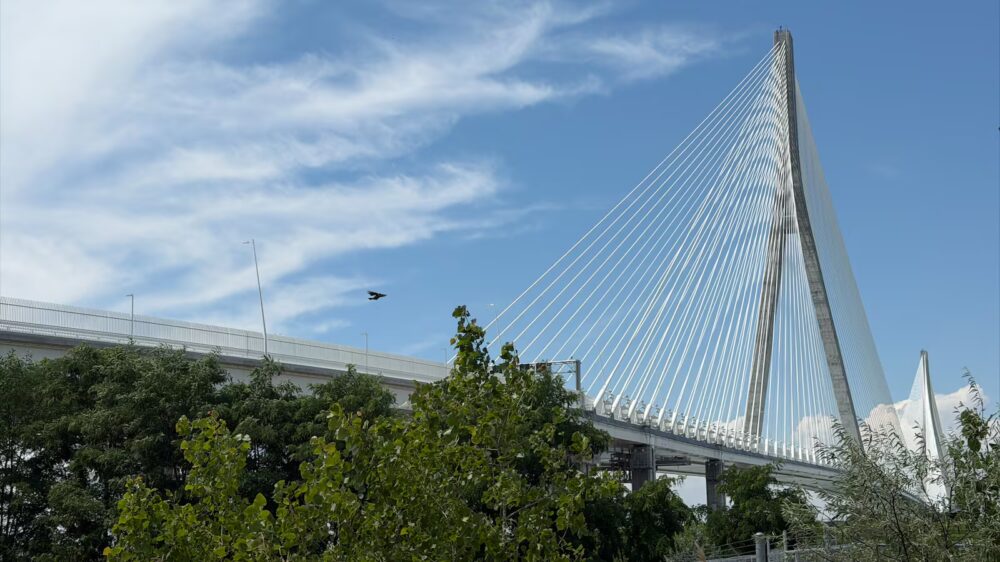
The Gordie Howe International Bridge connecting Detroit and Windsor, Ontario, will open on July 27, the government of Canada announced on Friday, after Trump blocked the initial opening in June.
A $4.5 billion structure was financed completely by the Canadian government at a border crossing that sees $300 million in trade on a daily basis, agreed upon by Canada and Michigan 13 years ago. Canada bore the full cost of construction, while ownership was to be jointly owned by Canada and Michigan.
Under the original agreement, once tolls recover the construction costs, perhaps 50 years from now, the two governments would split any revenue not needed for maintenance and operations.
Pete Hoekstra, the United States ambassador to Canada, claimed it was a “hoax” that Canada paid for the bridge.
Meanwhile, owner of the nearby Ambassador Bridge, billionaire Matty Moroun paid a Trump super PAC $1 million just before Trump announced he was blocking the original opening of the bridge in June.
The Ambassador Bridge has been notoriously neglected, with pieces of the bridge crashing to the ground on the Windsor side.
A new bridge deal was announced on Friday. And maybe it’s not so bad for Canada?
According to Canadian officials, half of the tolls, after deducting operating expenses, will go into a regional economic development fund for the first 15 years of operation. The money will be collected by the US Government, and the funds will only be available for use by Americans.
Under the original deal, tolls were to managed by representatives of both Canada and Michigan.
Toll increases above a 10% cost will also be approved by the US government.
Here’s the good part for Canada.
The split applies to net profits. Not toll revenue. Not gross receipts. Net. And in infrastructure finance, “net” is not a technicality — it is the entire ballgame.
Also, the American half doesn’t go to the U.S. Treasury. It goes into a regional economic development fund invested back into the Detroit side of the corridor.
Toll increases on the Moroun bridge have caused large numbers of trucks to abandon the Windsor crossing for another bridge about 100 miles north, between Sarnia, Ontario, and Port Huron, Michigan.
Canadian truckers are greatly relieved, and are expecting to see faster crossings, better security, and lower operating costs.
Trucks will now head straight to a modern border plaza designed to speed up inspections, particularly for agri-food shipments. Additionally, trucking companies are expecting to save between $20,000 to $100,000 annually.
Also:
Last month, Trump said he might not renew a free trade deal with Mexico and Canada.